Choosing a Male Enhancement Supplement: The Buyer's Checklist
Written by the Horsewood Daily editorial team
Last updated · Who reviewed this page · How we write and review
Choose a male enhancement supplement by its label, not its ad. Look for single amounts near studied doses, elemental minerals, support-only claims, a named lab report for your batch and a seller you can reach. Check the FDA tainted list too. Horsewood prints every amount, but tongkat ali is 10 mg against 100-600 mg in trials.
Why check a male enhancement label yourself? The Horsewood guide's case
Check the label yourself because no one checks it for you before sale. FDA does not have the authority to approve supplements for safety or effect before they are sold (FDA, 2022).
Health claims should rest on good human trials, and the product's dose and formula should match what was studied (FTC, 2022). Ads skip that part. The Supplement Facts panel cannot.
If you have erection trouble, see a doctor before you shop. The male vitality guide explains why ED is a heart signal first.
The Horsewood buyer's checklist: ten checks before you pay
Run these ten checks on any male enhancement supplement. Tick each one only when the label or the seller confirms it.
Before you buy, check: 0 of 10 checked
Which male enhancement ingredients have the most research?
Tongkat ali has the most research, and even that is thin. A meta-analysis pooled five small trials with 232 men, mostly using one water extract (Leisegang et al., 2022).
Here is how common ingredients rank.
| Ingredient | Evidence in humans | Look for on the label |
|---|---|---|
| Tongkat ali | Small trials, mostly 100-600 mg extract a day (Leisegang et al., 2022) | Extract mg and standardization |
| Saw palmetto | Large trials, little or no urinary benefit (Franco et al., 2023) | About 320 mg if included at all |
| Boron | One tiny trial, 10 mg elemental for a week (Naghii et al., 2011) | Elemental boron in mg |
| Nettle | Root studied for the prostate, results mixed (NIDDK LiverTox, 2023) | Root or leaf, and the amount |
| Horny goat weed | No rigorous proof of sexual benefit (NIDDK LiverTox, 2022) | Icariin content |
| Wild yam | Does not become hormones in the body (RxList, n.d.) | Claims of DHEA or testosterone |
| Sarsaparilla | Not enough evidence for any use (RxList, n.d.) | Steroid claims, which are false |
Each one is covered line by line on the ingredients page.
How do you compare a label dose with the research?
Put each label amount next to the daily dose used in human trials. A big gap means the trial results do not apply.
Here is the method, with the Horsewood tongkat ali line as the worked example.
- 1
Read the serving size
Find how many capsules make one serving. Every amount on the panel is per serving.
- 2
Write down each amount
List every milligram. Note any ratio like 100:1 and any chelate or compound weight.
- 3
Use the extract weight
Compare the extract amount, not the dry-herb equivalent printed beside it.
- 4
Find the studied dose
Look up the daily dose used in human trials for that same ingredient and plant part.
- 5
Divide and decide
Divide the studied dose by the label amount. A big gap means the trial results do not carry over.
Worked example: the label lists 10 mg of a 100:1 tongkat ali extract. Trials used 100-600 mg of extract a day, most often 200-400 mg (Leisegang et al., 2022). That makes the label 10 to 60 times lower. The “about 1,000 mg” beside it is the dry root the extract came from, not what the capsule holds.
What label math traps should buyers watch for?
Three traps make small amounts look big: extract ratios, chelate weights and the wrong plant part.
Boron shows the second trap. Labels should list elemental boron (NIH ODS, 2022), yet many print only the compound weight, like the 20 mg boron chelate on the Horsewood label.
A 100:1 ratio describes how the extract was made. Compare extract weight to extract weight.
A chelate weight includes the carrier. The elemental mineral is always less.
Nettle leaf is not nettle root. Prostate studies used the root (NIDDK LiverTox, 2023).
Does the ad match the label? The seller graphic test
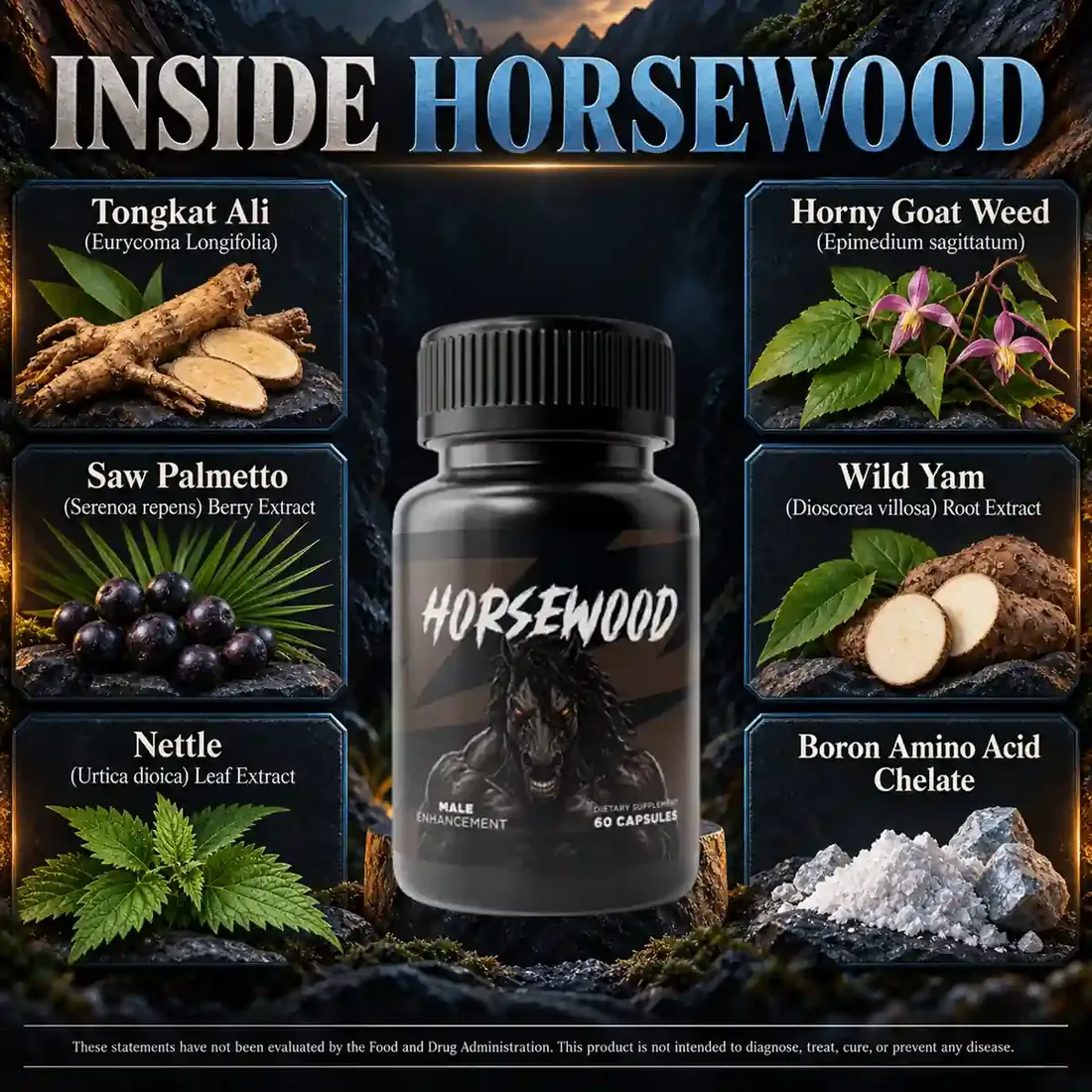
Set every ad, graphic and press release beside the bottle label. When they differ, the label wins.
Horsewood fails this test in several places. The sales page says one capsule a day while the label says two, a pack badge says vegetarian over a gelatin capsule, and the sales site says Made in USA where the label says Assembled in the USA.
What do third-party tested and FDA registered really mean?
Each badge has a narrow meaning, and none is a government approval. FDA does not issue registration certificates or recognize ones sold by private firms (FDA, 2024).
Even real quality seals check label accuracy, not safety or results (NIH ODS, 2023).
- Third-party tested: counts only with a named lab and a report for your batch.
- FDA registered facility: a factory listing, printed on the Horsewood label. It is not product approval.
- Lot and CoA numbers: useful only with a matching lab report. Horsewood's are draft labels.
Which ad tricks should make you walk away?
Walk away from ads that rush you, borrow authority or show reviews you cannot check. Since 2024, federal rules ban fake reviews, bought reviews and fake review sites (FTC, 2024).
Watch for these:
- A countdown timer or “while stock lasts” banner
- A doctor in a lab coat with no name or credentials
- University or NIH logos next to the product
- A claim of thousands of verified reviews with none shown
- Promises of size, stamina or results in a set number of days
The ad red flags post takes each trick apart.
Is a money-back guarantee a sign of quality? The Horsewood example
No. A guarantee protects your money, not your health, and the fine print decides how much it protects. Horsewood offers 60 days from purchase unless the sales page prints a longer window.
The buyer pays return shipping, and the brand's refund page says original shipping is not refunded. Its FAQ says to send bottles back empty, while the refund page asks for unused bottles, so confirm with the desk at +1 (302) 200-3480 first.
Horsewood scored against the buyer's checklist
Horsewood scores well on openness and seller contact, and poorly on doses and proof. Every amount is printed, but every amount is small and nothing has been lab-tested in public.
A weak score does not prove harm.
| Check | Horsewood result |
|---|---|
| Single amounts, no blend | Pass: all seven lines show mg |
| Doses near research | Fail: tongkat ali 10 mg vs 100-600 mg; saw palmetto 20 mg vs 320 mg |
| Elemental mineral listed | Fail: boron chelate weight only |
| Plant part matches research | Fail: nettle leaf, not root |
| Support-only claims | Pass on the label; the sales page adds stronger lines |
| FDA tainted list | Not found as of October 13, 2026 |
| Named lab and batch report | Fail: lot and CoA are draft labels |
| Ad matches label | Fail: dose, ingredient count, vegetarian and origin conflicts |
| Seller contact and returns | Pass: +1 (302) 200-3480 and a returns address |
| Checkable reviews | Fail: none verified yet |
Choosing a male enhancement supplement: common questions
Questions people type into Google and Bing, answered from the label and the sources on this page.
How do I choose a male enhancement supplement?
Choose by the label, not the ad. Look for single amounts near the studied doses, support-only claims, a named testing lab and clear refund terms, and see a doctor first if you have ED.
What should I look for on a male supplement label?
The serving size, each ingredient's amount, the plant part and any extract ratio. Then check the claims, the other ingredients and the warnings.
What are red flags in male enhancement ads?
Countdown timers, unnamed doctors in lab coats, borrowed university logos and review counts you cannot see. An expert in an ad must have real expertise and must have actually evaluated the product (FTC, 2023).
Do male enhancement pills really work?
No supplement is proven to treat ED, and most finished formulas have never been tested. The research covers single herbs, often at far higher doses than labels print.
Which ingredients have the most research?
Tongkat ali has the most, and the trials were still few, small and mixed (Leisegang et al., 2022). Saw palmetto has big trials too, but they found little or no benefit (Franco et al., 2023).
How do I know if a supplement has hidden drugs?
You cannot tell by looking. Check the FDA list, buy from a reachable seller and ask for a lab report that screens for drugs. FDA warns that many products in this category are likely contaminated (FDA, 2026).
What does third-party tested mean?
It should mean an outside lab checked the product. The claim only counts when the lab is named and you can read the report for your batch.
Are proprietary blends bad?
They are bad for buyers. A blend prints one total, so you cannot tell whether any ingredient reaches a studied dose.
How do I check the FDA tainted products list?
Search FDA's sexual-enhancement product notifications by product name. FDA says a product missing from that list is not proof it is safe (FDA, 2026).
Is a money-back guarantee a sign of quality?
No. A guarantee protects your money, not your health. Read who pays return shipping, whether opened bottles count and when the window starts.